

BUSINESS HOURS
Mon - Sun: 6am to 6pm
24/7 Emergency Work
Mon - Sun: 6am to 6pm
24/7 Emergency Work
SERVICE AREA
40km around Logan QLD
40km around Logan QLD
Severe storms can leave properties with dangerous tree damage that requires urgent attention. Split trunks, suspended branches, uprooted trees and debris near homes, fences or powerlines can continue to pose a risk even after the weather has passed. Knowing what to do next can help protect occupants, prevent additional property damage and support safer decisions about emergency tree removal in Logan.
Batchelor & Sons Tree Services understands the challenges presented by storm-damaged trees and the importance of responding carefully. This guide explains the immediate safety steps property owners should take, the warning signs that a tree may fail, who to contact, what information to provide and how future storm-related tree risks may be reduced.
The first priority after a storm is not cleaning up the yard. It is keeping people away from unstable trees, damaged structures and electrical hazards.
Storm-weakened trees can continue moving as wind, rain and soil conditions change. A branch that appears lodged securely may fall without warning, while an uprooted tree may shift further as saturated ground gives way.
Property owners should avoid going outside while strong winds, lightning, heavy rain or flooding are continuing. Remaining branches may fail during follow-up wind gusts, and wet ground can conceal holes, sharp debris or damaged electrical equipment.
Once conditions settle, the property should initially be inspected from a safe location. This may be from inside the home, from the street or from another part of the property that is well away from the damaged tree.
Do not stand beneath the canopy, walk under suspended branches or approach the trunk to inspect cracks and lifted roots.
Everyone should remain well outside the possible fall area of a damaged tree or branch. The appropriate boundary depends on the tree’s height, direction of lean, surrounding structures, slope and the position of broken limbs.
Where the safe distance is uncertain, move farther away and wait for professional advice.
Children, pets, visitors, neighbours and delivery drivers should be kept out of the affected area. Clear verbal warnings, temporary barriers or visible signs can be used from a safe location to prevent accidental entry.
Do not allow anyone to climb over fallen timber, move large branches, retrieve belongings or clear access beneath a damaged canopy. A small change in weight or position can cause a lodged limb or cracked trunk to fail.
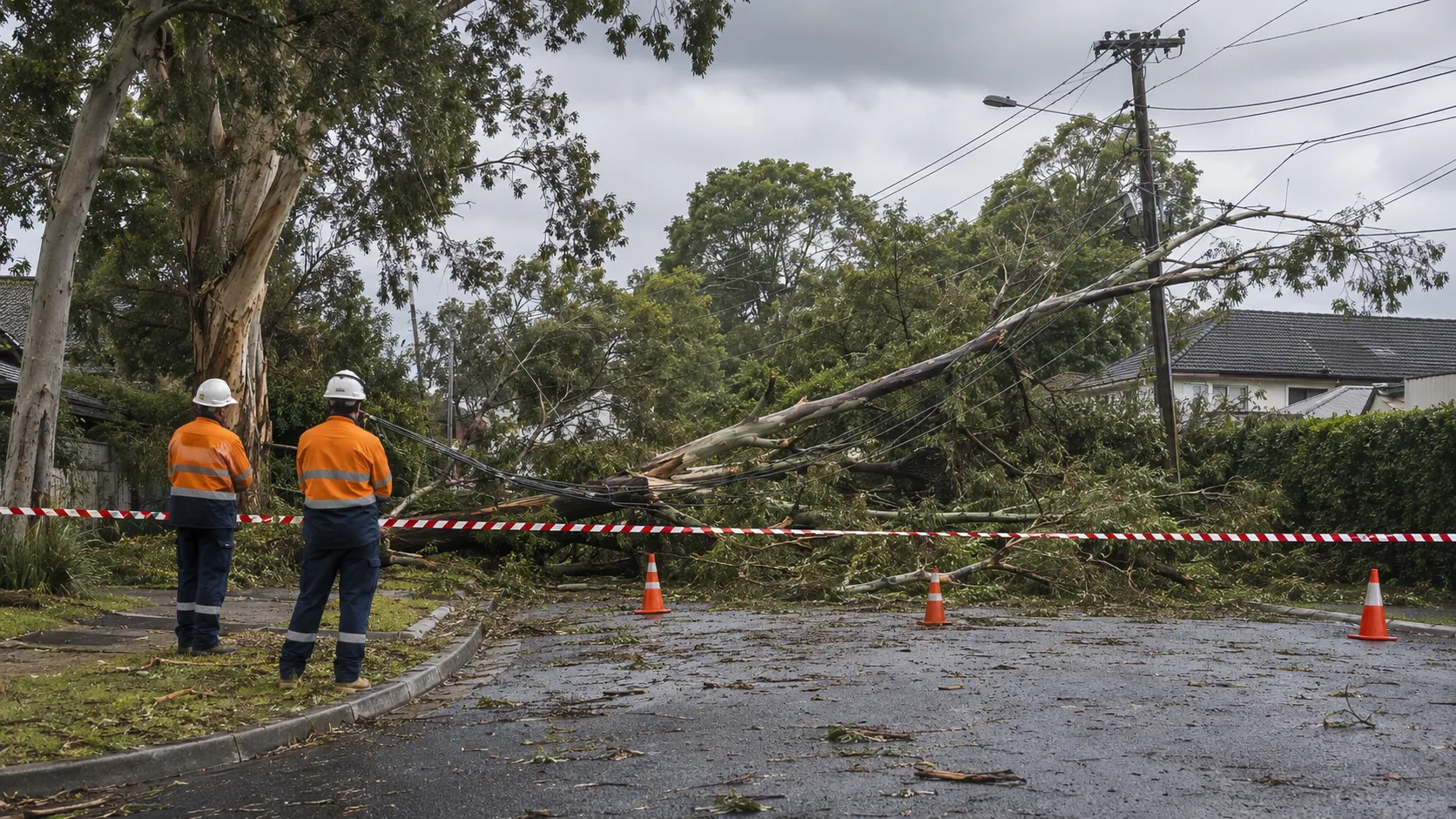
All fallen, low-hanging or damaged powerlines must be treated as live, even when they are not sparking or making noise.
If a tree, branch, fence, vehicle or structure is touching a powerline, keep everyone at least 10 metres away. Electricity can travel through wet wood, foliage, metal fencing and the surrounding ground.
Do not:
Call Triple Zero if there is an immediate threat to life, fire or a fallen powerline creating a public danger. Energex should also be notified so the electrical hazard can be made safe before tree work begins.
If a vehicle is touching a powerline and the occupants are safe inside, they should generally remain in the vehicle and wait for emergency assistance unless fire or another immediate danger makes remaining inside impossible.
A tree resting on a roof, carport, shed, verandah or fence can place the structure under considerable pressure. Rafters, support posts and wall framing may be damaged even when the exterior appears relatively intact.
Property owners should not climb onto the roof or use a ladder to inspect the damage. Moving the tree or placing additional weight on the structure may trigger a partial collapse.
Do not attempt temporary tarping until a builder, roofer or other suitably qualified professional has confirmed that the area can be accessed safely. Water entering the home may be managed by moving belongings away from the affected area, provided this can be done without entering a damaged section of the building.
Warning signs of structural movement can include:
Any area showing these signs should remain closed until it has been professionally assessed.
Not every storm-damaged tree has to be removed immediately. Some trees can be stabilised, pruned or monitored after assessment. Others present an unacceptable risk and require urgent make-safe work or complete removal. Knowing how urgent a tree problem may be helps distinguish an immediate safety hazard from damage that can be assessed and scheduled once conditions are stable.
Emergency tree removal may be necessary when a tree or major branch is unstable, is already damaging property or could fail into an occupied or frequently used area.
Professional assistance should be arranged promptly when:
Powerline hazards must be made electrically safe before an arborist or tree-removal crew begins work in the affected area.
A tree does not have to fall during the storm to remain dangerous. Delayed failures can occur hours or days later as damaged roots, split unions and saturated soils continue to deteriorate.
Fresh cracks in the ground, raised soil or movement around the base can indicate that the root system is losing its hold.
Important signs include:
Root damage may be difficult to see from a distance, so property owners should not approach the trunk to investigate closely.
Fresh vertical cracks, open seams or exposed wood can indicate that structural failure has begun.
Other warning signs include:
A split trunk may continue supporting the canopy temporarily, but its condition can deteriorate rapidly as wind and weight shift.
The loss of large branches from one side can change how the remaining tree carries its weight. A canopy that has tilted, twisted or become heavily one-sided may place extra force on the trunk and roots.
Suspended branches can also remain caught in surrounding limbs. These are sometimes called hangers and may fall with little warning.
No one should walk, park or work beneath a damaged canopy until it has been assessed.
The correct first contact depends on the type of hazard, the tree’s location and whether public infrastructure or insured property has been affected.
Call Triple Zero when there is an immediate threat to life, fire, serious injury, a collapsed structure or a fallen powerline creating a public emergency.
For non-life-threatening situations, property owners may be able to request storm assistance from the Queensland SES when a fallen tree is blocking access or threatening further damage. The SES can be contacted on 132 500, or assistance can be requested online.
Emergency services may establish an exclusion area, assist occupants or coordinate with the electricity network where required.
Energex should be contacted when:
Tree contractors should not begin cutting near an electrical hazard until the electricity network or another authorised electrical professional has confirmed that the area is safe.
A tree that is growing near powerlines but is not creating an immediate electrical emergency may require planned vegetation management rather than an emergency call. The correct process should be confirmed before pruning or removal is arranged.
Logan City Council may need to be contacted when:
Council involvement does not automatically mean that council will carry out or pay for all work. Responsibility can depend on the location of the tree, land ownership, the nature of the damage and applicable vegetation controls.
Residents can report tree damage on council land to Logan City Council and request an assessment when a council-managed tree has been damaged or presents a concern.
Property owners should confirm the appropriate process before engaging a private contractor for work on council land, unless immediate action is required to protect life.
The insurer should be contacted as soon as practical when a tree has damaged an insured building, fence, vehicle or other asset. Professional assistance with storm damage and insurance claims can also help property owners document the tree work and provide information requested during the claims process.
The insurer may ask for:
Where immediate work is necessary to prevent injury or additional damage, safety should not be delayed while waiting for routine claim approval. However, the insurer should still be notified as soon as possible, and all records and receipts should be retained.
An arborist is generally the appropriate contact when there is no uncontrolled powerline hazard and the damage involves trees on private property.
The arborist can determine whether the tree should be:
An arborist may also identify damage to nearby trees that was not immediately visible after the storm.
Photos and written notes may support an insurance claim, help explain the urgency of the work and create a record of the site before cleanup begins.
Documentation should only be collected from a safe location. No photograph is worth approaching a powerline, unstable structure, split trunk or suspended branch.
Begin with wide images showing:
Closer images may be taken only when the area can be approached safely. Useful details can include:
Do not climb onto a roof, stand under damaged limbs or cross an exclusion zone to obtain a better angle.
Where possible, keep the original image files and separately record the date and approximate time the damage was noticed. A fixed feature such as a wall, fence or letterbox may help show the size and location of the damage.
Property owners should retain:
Accurate records do not guarantee that every cost will be covered, but they can help demonstrate what occurred and why urgent action was considered necessary.
Providing clear information during the first call helps the tree service assess urgency, identify access requirements and determine which equipment may be needed.
Begin with the most serious safety issue.
Tell the team if the tree or branch is:
Any powerline contact, electrical noise or sparking should be mentioned immediately.
Helpful details include:
Photos taken from a safe position may help the crew understand the situation before arrival.
Tree-removal equipment may be difficult to position on properties with:
The crew should also be told about pets, septic systems, underground services, swimming pools and other site features that may affect access.
Have the following information ready:
Property owners should not approach or operate a wet or damaged switchboard to determine whether electricity has been disconnected.
Emergency tree removal begins with a site assessment. The crew will identify hazards, determine how the tree is supported and establish an exclusion zone around the work area.
The assessment may consider:
Where necessary, arborists may dismantle the tree in sections using rigging, elevated work platforms, cranes or other specialised equipment. Branches and trunk sections are controlled to reduce the likelihood of further damage to buildings, vehicles and surrounding property.
The tree may not always be removed completely during the first attendance. Heavy rain, unsafe ground, electrical hazards, limited access or continuing wind can prevent full removal.
In these circumstances, the crew may carry out temporary make-safe work, such as removing the most unstable sections or restricting access, before returning when conditions allow the remaining work to be completed safely.
Debris removal, stump grinding and restoration work may also be scheduled separately from the initial emergency response.

No property can be made completely immune to storm damage. However, regular inspections, appropriate pruning and better planting decisions can reduce avoidable risks.
There is no single inspection interval that suits every tree. The appropriate schedule depends on factors such as:
Trees close to homes, sheds, pools, driveways and frequently used outdoor areas may require closer attention.
An assessment should be arranged when a tree develops:
Professional pruning can remove dead or defective branches, improve clearance and manage excessive end weight on vulnerable limbs.
Appropriate work may include:
Severe lopping and indiscriminate topping should be avoided. These practices can leave large wounds, damage tree structure and encourage fast regrowth with weak attachments.
Pruning should be planned according to the tree’s condition and species rather than carried out as a last-minute response immediately before severe weather.
Construction and landscaping can affect tree stability long before symptoms become visible.
Potential problems include:
An arborist should be consulted before major work occurs near mature trees, particularly where the trees could strike a building or public area if they failed.
When a storm-damaged tree has to be removed, replacement planting should consider the available space, mature tree size, root behaviour, soil conditions and distance from buildings and utilities.
A suitable tree planted in the correct location is less likely to create avoidable conflicts as it matures.
Property owners can also reduce storm-related debris by maintaining gardens, removing loose material and addressing known hazards before severe weather arrives.
Recovering from a storm begins with putting safety before speed. Damaged trees can remain unstable long after the strongest weather has passed, particularly where trunks are split, roots have lifted or large branches remain suspended.
Property owners should stay clear of damaged trees, keep at least 10 metres from powerline hazards, avoid unstable roofs and structures and contact the appropriate authority or professional before cleanup begins. Photos and written records may support an insurance claim, but documentation should never involve entering a hazardous area.
Batchelor & Sons Tree Services has the experience and equipment required to assess storm-damaged trees, complete urgent make-safe work and carry out controlled removals where necessary. A careful professional response can help protect occupants, limit additional property damage and restore safe access after severe weather.